Hair growth oil: what to expect, and when a scalp spray is the better choice
6 min read Last updated: 7 October 2026

“Hair growth oil” is one of the most searched hair phrases in Qatar, and the promise behind it is big: longer hair in less time. Before you choose a product, it helps to know what a hair oil can and cannot do, and how a product for the lengths and ends differs from one for the scalp. This guide explains both in plain language, with a routine suited to Qatar’s heat and humidity and the signs that it is time to see a dermatologist.
What does hair oil actually do?
The hair we see and touch is made of fibres with no living cells; growth starts in the follicles beneath the scalp. That is why oil works mainly on the surface of the hair: it coats each strand with a thin layer that makes it feel softer, adds shine and reduces the look of frizz and puffiness.
When the ends are dry, they split and break more easily during combing and styling, so hair can look as if it is not getting longer even though it is growing. Reducing dryness and friction at the ends gives hair a neater look with less visible breakage. That is what a suitable oil blend can offer: care for the hair you already have, not faster growth.
Is there an oil or spray that makes hair grow longer?
No cosmetic oil or care spray has been proven to speed up hair growth or treat hair loss. Growth rate and hair density depend on factors such as genetics, age, hormones, nutrition and general health, and a product applied to the hair does not change them.
So be cautious with any promise of a set number of extra centimetres, or of stopping hair fall within days. If the reason you are searching is noticeable shedding or ongoing thinning, the first step is to find the cause with a dermatologist, not to try one product after another.
Oil for the ends or a spray for the scalp?
Oil and spray do not compete; each has its own place. Choose according to what bothers you about your hair:
- Dry or split ends, frizz and puffiness, or a rough feel: an oil blend on the lengths and ends.
- Care for the scalp, the roots and the look of fuller hair without a greasy feel: a light scalp spray.
- A naturally oily scalp: avoid putting oil on the scalp and keep it to the ends.
- Very fine hair: start with less oil, because a large amount weighs hair down.
Two NORIVA Care products: a scalp spray and an oil for the ends
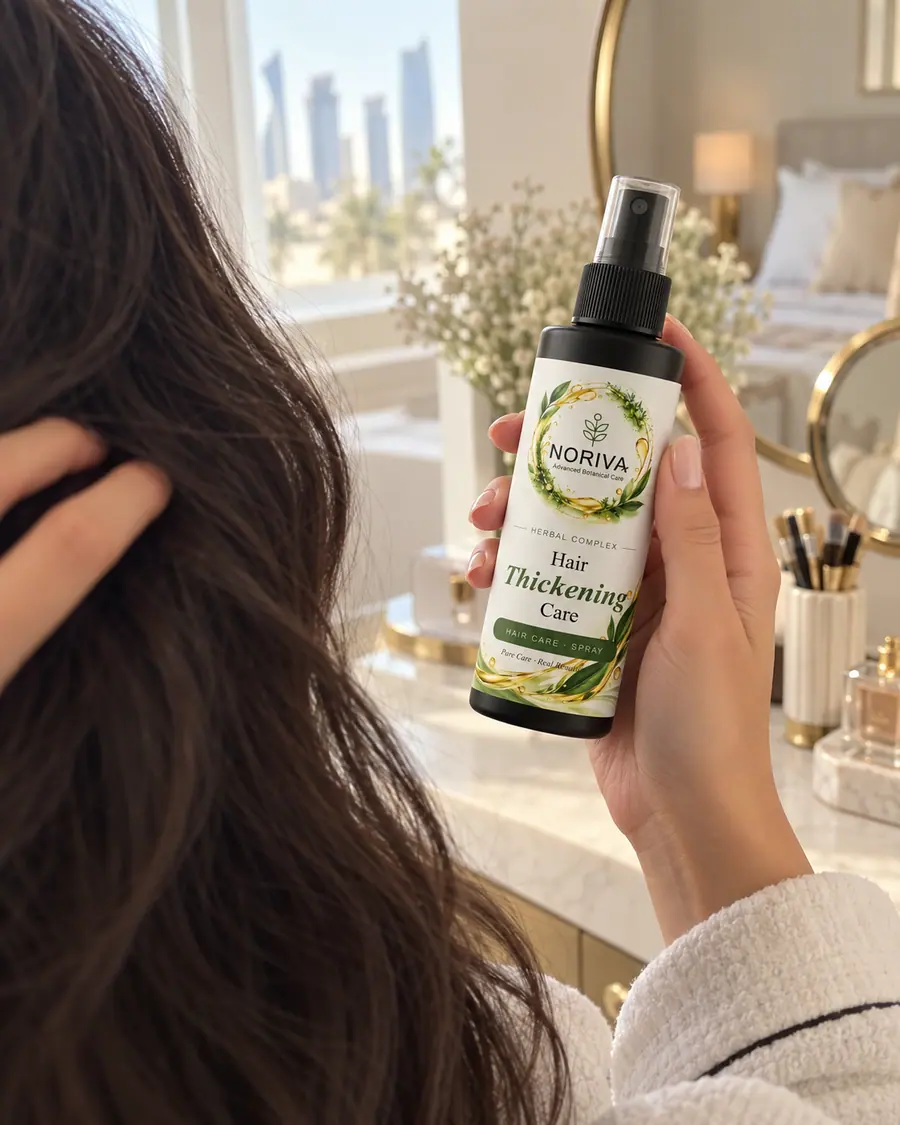
The Hair Thickening Care Spray is a spray, not an oil: a light mist applied to a clean scalp and roots to care for the look and visible fullness of your hair. Spray the amount shown on the pack, then massage the scalp with your fingertips for a minute. It is a cosmetic product, not a treatment for hair loss.
The Hair Smoothing Blend is an oil blend for the lengths and ends, used after showering or before heat styling for a softer feel, easier styling and a less frizzy look. Two to three drops are enough for medium-length hair, from mid-lengths to ends.
A routine for Qatar’s heat and humidity
Heat outside, air conditioning inside and humidity in some months dry out the ends and add frizz, while the scalp can get oilier with sweat. A simple routine is enough:
- Wash with lukewarm, not hot, water, as often as suits your scalp.
- On a clean scalp, apply the amount of scalp spray shown on the pack and massage with your fingertips for a minute.
- Spread two to three drops of the oil blend from mid-lengths to ends; it is easier to spread on damp hair.
- Do not put heavy oil on the scalp on hot, sweaty days.
- Cover your hair in the midday sun, and use the lowest heat that works on your hair dryer and straightener.
Patch test before first use
Any new hair or scalp product deserves a simple test before full use, especially if your scalp is sensitive or you have reacted to care products before.
- Check the ingredient list on the pack; you can ask us for a photo of the label before buying.
- Apply a small amount to a small area of skin, such as behind the ear or the inner elbow.
- Wait at least 24 hours and watch the area.
- If itching, redness or burning appears, do not use the product and rinse the area with water.
- If irritation appears after you start using it, stop the product, and see a doctor if symptoms persist.
When should you see a dermatologist?
Care products look after how hair looks and feels, but they do not diagnose or treat the cause of hair loss. See a dermatologist if you notice:
- Sudden shedding or hair falling out in large amounts.
- Gaps or bald patches.
- Thinning that gradually increases at the parting or the front of the head.
- Ongoing itching, pain, redness or scaling on the scalp.
- Hair loss after an illness, childbirth or starting a new medicine.
Sources
Frequently asked questions
Does hair oil really make hair grow longer?
No cosmetic oil has been proven to speed up hair growth. Oil cares for the lengths and ends, making them feel softer and reducing the look of frizz and breakage, but it does not change how fast hair grows.
Is the NORIVA Hair Thickening Care Spray an oil?
No. It is a light spray for the scalp and roots, applied to a clean scalp and massaged in with your fingertips for a minute. It is a cosmetic product for the look of your hair, not a treatment for hair loss.
Should I put hair oil on my scalp?
The Hair Smoothing Blend is made for the lengths and ends, and it is best to avoid the scalp if your hair tends to get oily. For the scalp and roots, use a product made for them, such as the scalp spray.
Can I use the spray and the oil together?
Yes, each in its place: the spray on a clean scalp, and two to three drops of the oil blend on the lengths and ends. Patch test each product on a small area before first use.
When should I see a doctor about hair loss?
If shedding is sudden or heavy, gaps appear, thinning increases over time, or there is ongoing itching, redness or scaling on the scalp. Care products do not treat hair loss; a dermatologist can find the cause and the right treatment.
This content is general information and not a substitute for medical advice. NORIVA Care products are care products; they do not diagnose or treat any health condition.